
Low-voltage series
DFX Series
Cable branch boxes are used only for cable branching. Their main function is to split or transfer cables, primarily performing cable splitting and cable transfer functions. With the development of cable-based distribution networks, when independent loads of modest capacity are relatively concentrated, cable branch boxes can be used for multi-branch cable connections, because the branch box allows direct operation of each circuit. 1. Cable splitting function. On a relatively long line, multiple small-cross-section cables often result in wasted cable, so in outgoing circuits to loads, a large main cable is often used for the outgoing run, and then near the load a cable branch box is used to split the main cable into several small-cross-section cables, which connect to the loads. This wiring method is widely used in urban grids for street lighting and small-user supply. 2. Cable transfer function. On a relatively long line, where cable length cannot meet the line requirement, cable joints or cable transfer boxes must be used. Usually cable intermediate joints are used for short distances, but for longer lines, based on experience on cable lines above 1000 m, if there are multiple intermediate joints in the cable, cable branch boxes will be considered for transfer to ensure safety. The DFX low-voltage cable branch box conforms to standards such as IEC61439 Low-voltage switchgear and controlgear assemblies and GB/T7251.5-2017 Low-voltage switchgear and controlgear assemblies Part 2: Assemblies for power distribution and control.
Request a quotePlease provide your operating conditions, quantity and required connection or output.
Technical details
Specifications from source material
Cable branch boxes are used only for cable branching. Their main function is to split or transfer cables, primarily performing cable splitting and cable transfer functions. With the development of cable-based distribution networks, when independent loads of modest capacity are relatively concentrated, cable branch boxes can be used for multi-branch cable connections, because the branch box allows direct operation of each circuit. 1. Cable splitting function. On a relatively long line, multiple small-cross-section cables often result in wasted cable, so in outgoing circuits to loads, a large main cable is often used for the outgoing run, and then near the load a cable branch box is used to split the main cable into several small-cross-section cables, which connect to the loads. This wiring method is widely used in urban grids for street lighting and small-user supply. 2. Cable transfer function. On a relatively long line, where cable length cannot meet the line requirement, cable joints or cable transfer boxes must be used. Usually cable intermediate joints are used for short distances, but for longer lines, based on experience on cable lines above 1000 m, if there are multiple intermediate joints in the cable, cable branch boxes will be considered for transfer to ensure safety. The DFX low-voltage cable branch box conforms to standards such as IEC61439 Low-voltage switchgear and controlgear assemblies and GB/T7251.5-2017 Low-voltage switchgear and controlgear assemblies Part 2: Assemblies for power distribution and control.
- Note
- Special requirements can be discussed with the manufacturer
- Rated operational voltage (Ue)
- V 400 Rated operational current (In): A ≤630 Rated frequency (Fn): Hz 50 Rated insulation voltage (Ui): V 690 Rated short-time withstand current (Icw): kA 15, 20 Rated peak withstand current (Icw): kA 40 Rated impulse withstand voltage (Uimp): kV 6 Overvoltage category: IV Pollution degree 3 Clearance: ≥10 mm Creepage distance: ≥12.5 mm Degree of protection: (customizable for special requirements) IP34D, IP44
Full product details
Overview
Cable branch boxes are used only for cable branching. Their main function is to split or transfer cables, primarily performing cable splitting and cable transfer functions. With the development of cable-based distribution networks, when independent loads of modest capacity are relatively concentrated, cable branch boxes can be used for multi-branch cable connections, because the branch box allows direct operation of each circuit. 1. Cable splitting function. On a relatively long line, multiple small-cross-section cables often result in wasted cable, so in outgoing circuits to loads, a large main cable is often used for the outgoing run, and then near the load a cable branch box is used to split the main cable into several small-cross-section cables, which connect to the loads. This wiring method is widely used in urban grids for street lighting and small-user supply. 2. Cable transfer function. On a relatively long line, where cable length cannot meet the line requirement, cable joints or cable transfer boxes must be used. Usually cable intermediate joints are used for short distances, but for longer lines, based on experience on cable lines above 1000 m, if there are multiple intermediate joints in the cable, cable branch boxes will be considered for transfer to ensure safety. The DFX low-voltage cable branch box conforms to standards such as IEC61439 Low-voltage switchgear and controlgear assemblies and GB/T7251.5-2017 Low-voltage switchgear and controlgear assemblies Part 2: Assemblies for power distribution and control.
Operating Environment
Ambient air temperature not higher than +40°C and not lower than -30°C. The average temperature within 24 h shall not exceed +35°C. For indoor installation, the altitude of the installation site shall not exceed 2000 m. Relative humidity of ambient air shall not exceed 50% at a maximum temperature of +40°C; higher relative humidity is permitted at lower temperatures (e.g., 90% at +20°C). The possible occasional effects of condensation due to temperature changes shall be taken into account. During installation, the inclination from the vertical shall not exceed 5°. The equipment shall be installed where there is no severe vibration or shock and where electrical components will not be corroded. Note: Special requirements can be discussed with the manufacturer.
Technical Parameters
Rated operational voltage (Ue): V 400 Rated operational current (In): A ≤630 Rated frequency (Fn): Hz 50 Rated insulation voltage (Ui): V 690 Rated short-time withstand current (Icw): kA 15, 20 Rated peak withstand current (Icw): kA 40 Rated impulse withstand voltage (Uimp): kV 6 Overvoltage category: IV Pollution degree 3 Clearance: ≥10 mm Creepage distance: ≥12.5 mm Degree of protection: (customizable for special requirements) IP34D, IP44
Dimensions
Height (mm) 1200~2000 Width (mm) 300~1000 Depth (mm) 300~700
Product Features
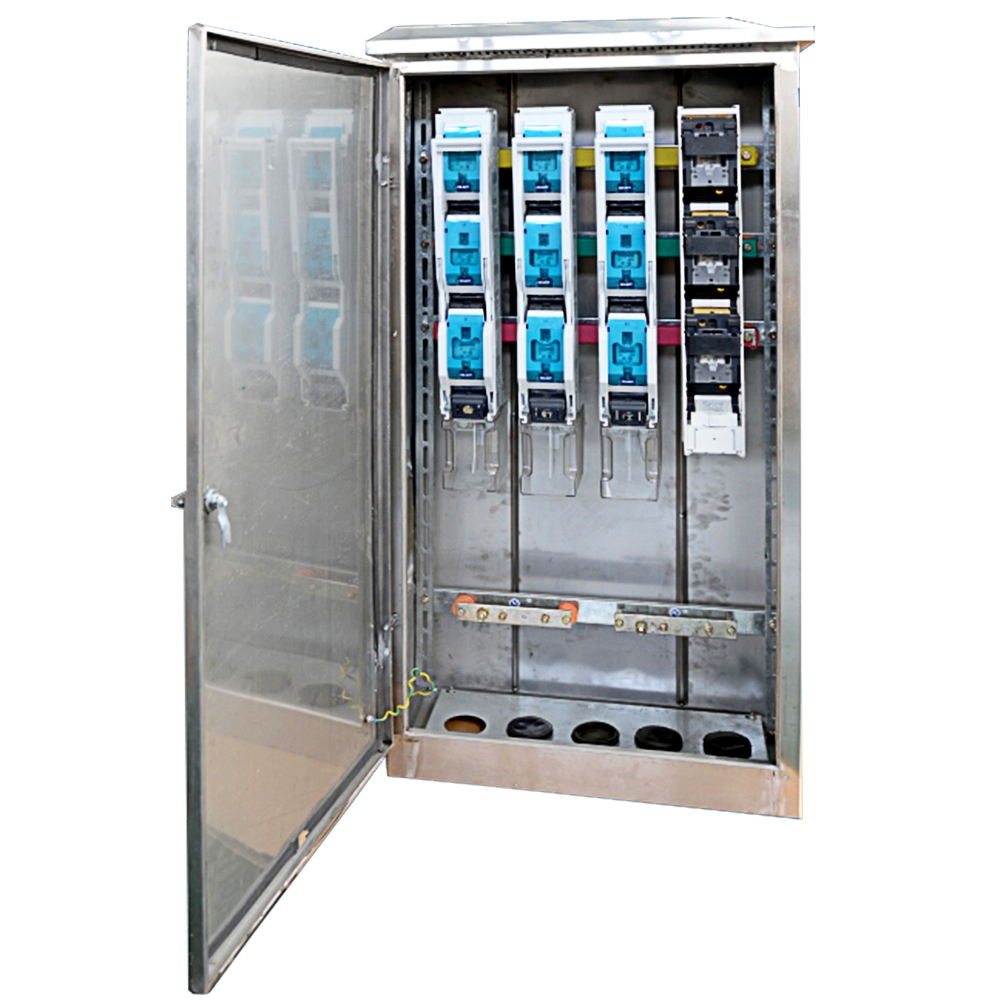
The DFX cable branch box consists of an enclosure, fuse-type disconnect switch, fuses, horizontal busbar, N busbar, PE busbar, insulated conductors, etc. The enclosure is made of bent and partially welded carbon steel or stainless steel plate, with rigidity and load-bearing capacity meeting the installation requirements of electrical components. The front has a door; the rear is either openable or closed; a top cover is fitted to the cabinet top to achieve degree of protection IP34D. The horizontal busbar is located in the middle of the box, with heat-shrink tubing on part of it; the N and PE busbars are tin-plated on the surface. Auxiliary circuit insulated conductor wiring method: insulated conductors bundled with spiral wrap / fixed with cable ties / fixed in wiring ducts. Prototype operation mode: manual Prototype installation mode: floor-standing fixed installation Enclosure material: metal Main grounding screw: M12 galvanized iron Anti-corrosion measures: the enclosure uses carbon steel or stainless steel plate, and internal metal accessories use galvanizing, providing corrosion resistance. Degree of protection: the cabinet generally has degree of protection IP34D; users may also select between IP30 and IP44 according to the requirements of the operating environment.